When Memory Fades, Clarity Can Deepen


Crossing the "Second Spring" and learning to trust orientation over recall
Over the last few years, many thoughtful, capable people I know have quietly shared something they don’t usually say out loud.
They don’t frame it as a crisis.
They don’t dramatize it.
In fact, they often minimize it before they name it.
They say things like:
- “I feel less sharp than I used to.”
- “I can’t hold as much in my head.”
- “I lose my train of thought more easily.”
- “I don’t trust my memory the way I once did.”
Nothing is obviously wrong.
Their lives are functioning.
Their relationships are intact.
And yet—something feels unsettling.
For people who have built their lives on competence, insight, and mental clarity, this shift can feel quietly frightening. Not because it’s dramatic, but because it’s hard to locate. It doesn’t announce itself as a problem, yet it subtly erodes confidence.
What’s most difficult is not the forgetting itself.
It’s the private question that follows:
If I can’t trust my mind the way I used to, what can I trust?
The Part We Rarely Name
Most people don’t talk about this fear directly.
It feels embarrassing.
Or self-indulgent.
Or premature.
After all, nothing catastrophic has happened.
And yet, somewhere beneath the surface, a comparison begins to form—between who we remember ourselves being, and who we seem to be now.
- A quieter mind that once felt decisive
- A fog where certainty used to live
- A subtle hesitation before speaking
The tension isn’t about intelligence.
It’s about reliability.
A sense that the inner compass we relied on for decades is no longer responding the same way.
That loss of trust—more than memory itself—is what destabilizes us.
A Shift That Often Goes Unnamed
For much of our early and midlife, clarity is closely tied to recall.
We know who we are because we can remember:
- what we’ve learned
- what we’ve accomplished
- how things fit together
- how to explain ourselves and the world
This form of intelligence is powerful. It allows us to build careers, families, identities, and systems. It rewards speed, precision, and mastery.
It also gives us confidence—because it feels dependable.
But it is not the only way of knowing.
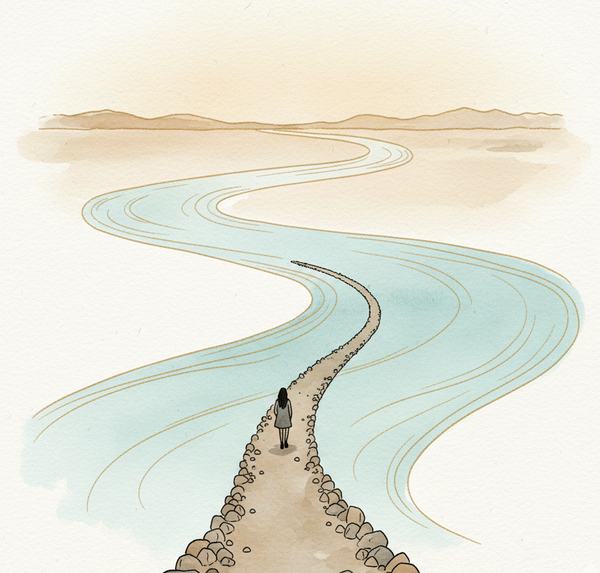
As we move into the second half of life—what some traditions call the Second Spring—another form of intelligence begins to emerge. And it often arrives disguised as loss.
Details slip more easily.
Narratives loosen.
The sense of “I’ve got it all in my head” fades.
At the same time, something else begins to surface.
A felt sense of what matters.
An immediate recognition of what is misaligned.
A quieter clarity that doesn’t come from thinking things through.
A simple metaphor helps name this transition:
Early in life, we carry the map.
Later in life, we are asked to become the compass.
The trouble is, we often keep judging ourselves by the old scorecard.
Why Confidence Takes a Hit
Confidence rarely disappears all at once.
It erodes when the measures we trust stop working.
If your sense of self has been anchored in mental sharpness, recall, and internal coherence, then a shift away from those capacities can feel like personal failure—even when it’s developmental.
You may find yourself wondering:
- “Why can’t I think like I used to?”
- “Am I falling behind?”
- “Shouldn’t I be clearer by now?”
These questions make sense. They’re just aimed in the wrong direction.
Second-half-of-life clarity is not about holding more inside.
It’s about sensing more accurately from where you stand.
Until that shift is understood—and trusted—it can feel deeply destabilizing.
From Recall to Orientation
What’s changing is not intelligence.
It’s how clarity is organized.
Earlier in life, clarity depends on accumulation:
- knowledge
- experience
- internal maps
Later in life, clarity depends on orientation:
- knowing what matters now
- sensing what fits and what doesn’t
- recognizing when to act—and when not to
This kind of clarity doesn’t require constant sharpness.
It requires the ability to return.
You don’t need to stay clear all the time.
You need to trust that you can find your way back.
That trust—not recall—is the foundation of elder confidence.
A Different Relationship with Memory
When memory becomes less reliable, it’s tempting to see that as loss.
But often, what’s actually happening is a rebalancing.
Energy that once went into storage and recall begins to flow toward:
- perception
- discernment
- presence
Clarity becomes quieter.
Less impressive.
More grounded.
It shows up not as answers, but as:
- knowing when something is not true
- sensing misalignment early
- trusting a pause instead of forcing a decision
This kind of knowing doesn’t announce itself.
But it is steady.
And it is enough.
Working with the Shift Instead of Resisting It
One way to support this transition is by learning to orient before trying to understand.
Instead of asking:
- “Can I remember this?”
- “Can I explain this?”
- “Can I hold this all together?”
We learn to ask:
- “What is already clear right now?”
- “What feels coherent without effort?”
- “What can I let rest?”
Clarity often returns when we stop chasing it.
A Simple Anchor When the Ground Is Shifting
For many people crossing this threshold, what helps most is not more insight, but a simple point of orientation—something that can be returned to when clarity feels diffuse.
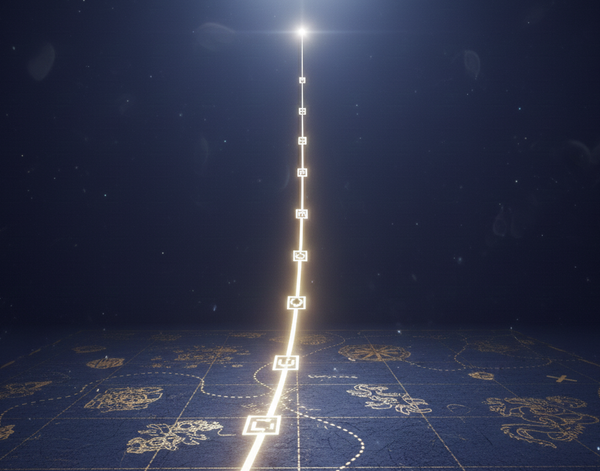
One such anchor is what I call a North Star.
Not a goal.
Not a plan.
Not a vision of who you should become.
A North Star is a brief, living statement that names what feels most true, steady, and essential in this season of life. It doesn’t try to capture everything. It simply points.
When recall is unreliable, having a North Star outside your head can be surprisingly grounding. It offers a way to re-orient without effort—especially on days when thinking feels heavy or confidence wavers.
Used well, a North Star doesn’t tell you what to do.
It helps you remember how to listen.
That’s often enough.
Why the Limits Matter
This transition can’t be rushed.
It can’t be solved by thinking harder.
And it can’t bypass uncertainty, grief, or fatigue.
Rest, movement, time in nature, and human connection matter more than insight during this phase. If the body is exhausted, clarity will be unreliable—no matter how wise the framing.
The measure is simple:
If clarity deepens and warmth remains, the path is sound.
If complexity grows and self-trust shrinks, it’s time to slow down.
A Different Definition of Clarity

At this stage of life, clarity no longer means:
- having answers
- knowing what comes next
- being able to explain everything
It means:
- staying oriented in uncertainty
- trusting what is quietly consistent
- knowing when enough is enough
If your memory feels less dependable these days, you may not be losing ground.
You may be learning to trust a deeper, steadier way of knowing.
Closing
Transitions are difficult precisely because the old supports fall away before the new ones feel solid.
But the fading of recall is not the fading of wisdom.
It is an invitation to live from orientation rather than accumulation—to become less preoccupied with holding everything, and more attuned to what is true right now.
If clarity feels harder lately, you may not be losing your way.
You may be crossing the Second Spring—and discovering that, in the right season, clarity can deepen.
👉 If you're interested in our current retreat:
https://www.sacredpath.solutions/the-second-spring-retreat/
and our group work:
https://www.sacredpath.solutions/begin-your-journey-on-the-sacred-path/